IV. What choices of Breathing Exercises do I have?
Course speech
Counting in Breathing
- Whenever you sit down, concentrate on your breathing in and breathing out.
- Count to ten as you breathe in, and then repeat the count as you breathe out; or just count to whatever number or even words which you feel comfortable with.
- If you are distracted or you lose concentration,do not worry, just relax and start the counting all over again.
- If you happen to forget the system you use for counting, just choose any number from 1 to 100 and carry on.
- After using breath counting for a period of time, you can stop the counting and just focus on the breathing in and the breathing out.
Whichever meditation method you try, you can start by practising for just 5-10 minutes at a time and then extend to 20-30 minutes after two to three weeks. Studies have shown that the most important thing is to practise regularly. If you are interested in the practice of meditation, we recommend that you do it at a centre or with an instructor, so that you are more likely to stick to your meditation routine.


Colour Breathing
Think of Colour Breathing in the same way as how colours can be used as a healing agent of relaxation and calm. Colour imagery connects our thoughts and feelings with changing perspectives associated with a colour to relax and calm down. You can use the following colours to represent different imageries:
- Blue: Blue inhaled air, can be relaxing.
- Orange: Orange exhaled air brings joy, happiness and fun. The secondary colour of orange is blue.
- Red: Red inhaled air releases repetitive anxiety or stress.
- Green: Green exhaled air, purifies your body and helps us to feel more balanced. The secondary colour of green is red.
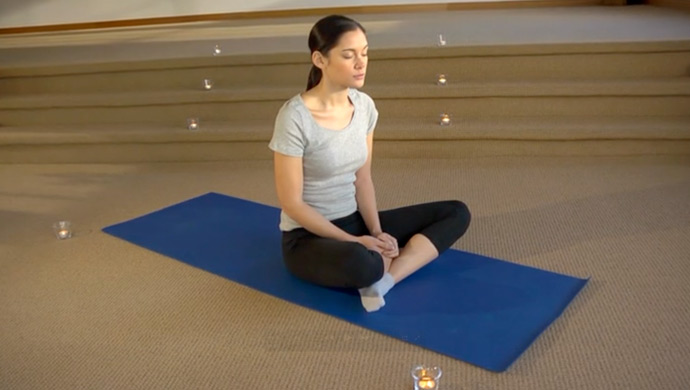
- Sit or lie down, keeping your spine straight but relaxed.
- Focus on your breathing until it has a natural rhythm.
- Think and feel positive emotions as well as the feeling of movement within your body.
- Select a colour, then inhale.
- Think of a colour moving into the upper abdomen and then spreading to the outer skin.
- As you exhale, think of the complementary colour.
Continue with the colour breathing for 10 to 30 minutes or until you achieve a calm feeling.
Diaphragmatic Breathing
Diaphragmatic breathing involves engaging your diaphragm for greater lung expansion. Engaging your diaphragm will help you strengthen it for everyday use. In order to strengthen this muscle, inhaling is supposed to take twice as long as exhaling. The only thing you will need to do diaphragmatic breathing is finding a comfortable place to practice.
This breathing technique is the basis for many other breathing activities. It can also replace your everyday, shallow breathing that comes from the chest. You can first use it as a breathing exercise, and then begin practising it during day-to-day activities, until it becomes your normal method of breathing.
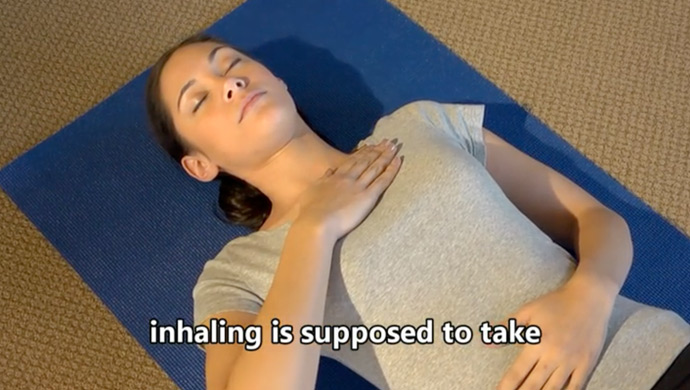
Instructions:- Lie on your back with your knees bent upwards.
- Place one hand immediately below your rib cage (where your diaphragm is located), and the other on your chest.
- Inhale, making sure that the hand below your rib cage moves out, and the one on your chest remains as still as possible. Then exhale.
- Inhale again to a count of 3, and then exhale to a count of 6.
- Repeat this breathing process until you are tired.
- With repeated practice, you should be able to reach about 12 diaphragmatic breaths each time.
- When you are able to do this exercise, try the exercise sitting down, then while you are walking.
- With practice, you may eventually be able to breathe regularly using your diaphragm, instead of the chest.
Abdominal Breathing
You can use this simple breathing exercise at any time in order to calm anxiety and ease tension. As with other breathing exercises, you do not need to have a special time or place to practise.
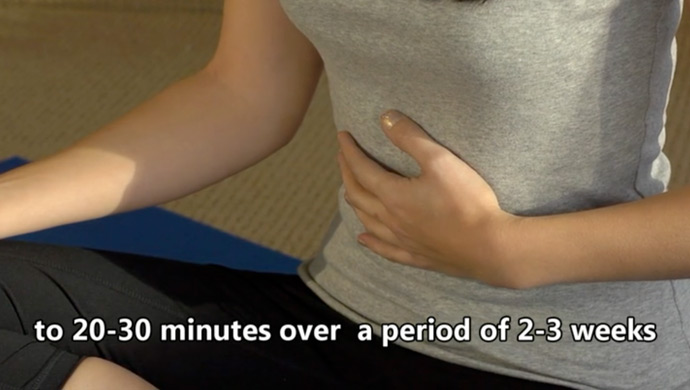
Instructions:- Put one hand on your stomach.
- Inhale through your nose slowly and deeply, and hold the air in the lowest part of your stomach. If you are using abdominal breathing, then both your hands should be raised. As you breathe and expand your abdomen, your chest should only move slightly. (In abdominal breathing, the diaphragm separating the chest and abdominal muscles are pressed down to enable the muscles surrounding the abdominal cavity to expand outward).
- When you inhale fully, pause for a moment, and then exhale slowly through the nose or the mouth, and ensure that your body is completely relaxed (your arms and legs as loose and supple as a rag doll).
- Take ten slow and full abdominal breaths. You must not take big gulps of air or breathe quickly if you are to achieve a steady and regular breathing. Inhale slowly, count (one - two - three - four), and then exhale slowly. Measured breathing will help slow down your breathing. Pause at the end of each inhalation and exhalation before starting the next breathing cycle. Counting down each breath from ten to one, is a good yardstick.
Follow this procedure:
Slow breathing .... Pause .... Slow breath ("Ten").
Slow breathing ....Pause .... Slow breath ("Nine").
Slow breathing ....Pause .... Slow breath ("Eight").
And so on, until the count is one. During abdominal breathing exercises, if you start to feel dizzy, stop for fifteen to twenty seconds and then start again. - You can extend this exercise by doing two or three sets of abdominal exercises. Remember to count down from ten to one per set. With only five minutes of abdominal breathing, the symptoms of anxiety or panic are significantly reduced.
You can use this simple breathing exercise at any time in order to calm anxiety and ease tension. As with other breathing exercises, you do not need to have a special time or place to practise.
Instructions:- Sit or stand in a comfortable position.
- Keep your shoulders down, back straight and elbows bent. Breathe deeply and hold your breath for five seconds.
- Slowly exhale.
- Repeat stomach breathing.
Mind-Focusing Breathing
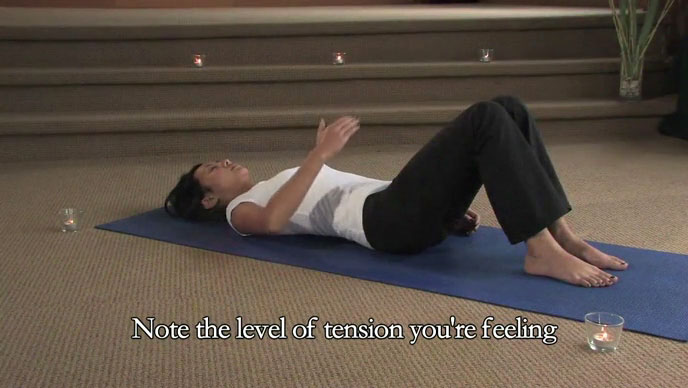
Mind-focusing breathing is designed for you to use the breathing process to recognise and release the worrying and stressful thoughts associated with your anxiety. Unlike focused breathing, where deep breathing techniques are used to take away the worries altogether, mind-focusing breathing helps you to acknowledge the stressful thoughts and to let go of them whilst breathing. You only need a bit of space and time to practise mind-focusing breathing.
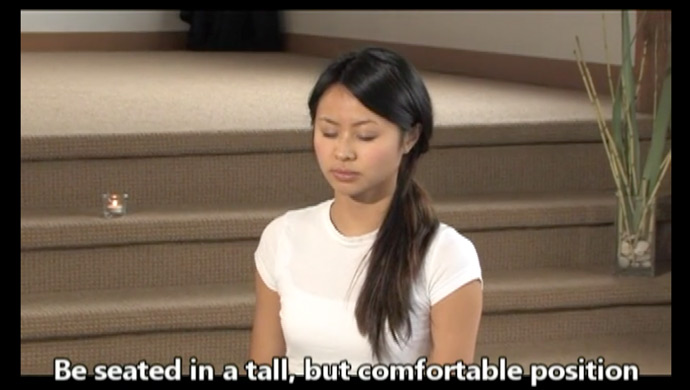
Instructions:- Sit up straight and comfortably. Breathe through the nose slowly and gently.
- As worrying or anxious thoughts enter your mind, acknowledge them without questioning. After acknowledging these thoughts, let go of them as you breathe.
- Continue breathing through the nose slowly and gently.
- Repeat the process for each worrying or anxious thought.
“Smile” Breathing
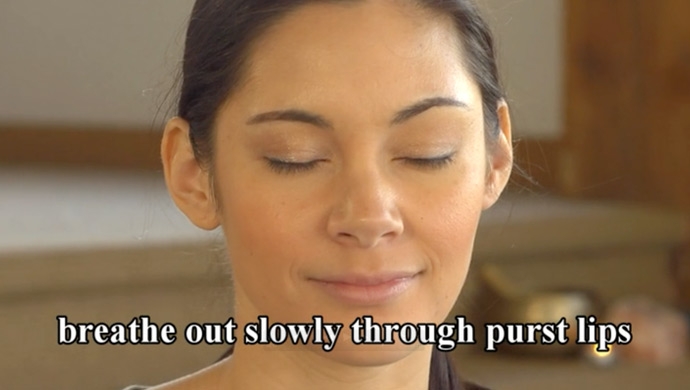
Smile breathing is a modification of mindfulness breathing to address feelings of physical pain that may lead to anxiety about a physical illness, or stems from a physical illness caused by anxiety. You can use it immediately when you are feeling stressed or have negative thoughts that are leading to anxiety. In this exercise, you will be able to acknowledge and breathe through the pain you feel, and channel positive energy from smiling to lower the pain sensation. Use this breathing technique when you feel pain; it will only take a few minutes.
Instructions:- You can be seated standing or lying down at any time you are experiencing pain.
- As you are feeling the pain, allow yourself to smile; hold the expression.
- While still smiling, sense yourself inhaling through the smile and through the nose
- Direct the positive energy from smiling and the breath to the part of your body that is experiencing pain
- Breathe out slowly through pursed lips
- Repeat this breathing process for about 5 minutes.
With this exercise, you have an instant tool against panic. As you become more comfortable with your breathing, try to use other breathing exercises in this lesson as an even stronger prevention for anxiety before rapid breathing can start.
Preventing Hyperventilation with a Paper Bag
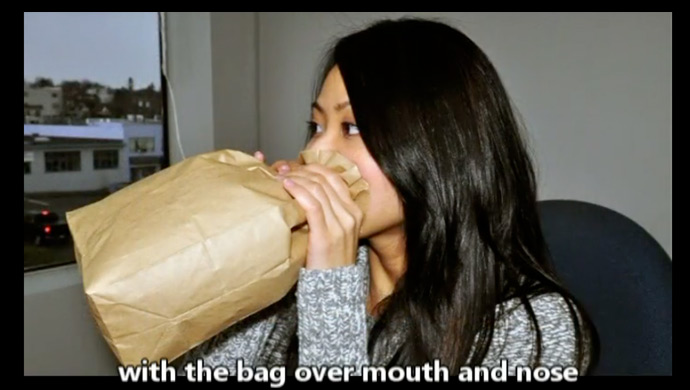
This is a quick and effective exercise that you can do anytime you hyperventilate due to stress or panic. When you use this technique, you will be able to calm yourself much quicker by using a paper bag to help you re-adjust the oxygen you inhale, and release the extra carbon dioxide from your system. The paper bag will stop hyperventilation and possible fainting.
Instructions:- Open an empty paper bag and hold it in such a way that the opening of the bag covers both your mouth and nose. Never use a plastic bag.
- Breathe in slowly for a count of 10 and then breathe out slowly for another count of 10. You are breathing properly when your stomach contracts when you breathe in and then releases when you breathe out.
- Take the bag away from your mouth and nose, and breathe 6-12 times. Your breathing rate should be the same as when you were breathing with the bag.
- Take 3-4 deep breaths from your stomach (see instructions on stomach breathing exercise).
- Repeat the breathing into the paper bag, but do not use this breathing cycle until your breathing slows back down to normal.
- Continue breathing this way for 20–30 minutes.
You can easily keep a paper bag in your handbag or pocket and use this breathing exercise to reduce panic. As you recover, you will need it less and less. The bag will only be an emergency tool used in case of a panic attack.
In addition, you can use a senitary mask to replace the use of paper bag. It also have the effect of ventilation. As in nowadays, it is very acceptable and popular to wear a sanitary mask for hygiene purpose and it doesn’t looks strange and embracing in the public.
Focused Breathing
This exercise will require you to breathe from the stomach, deeply and to a rhythmic count so that you can focus your mind away from worrying and stressful thoughts. You need time and a comfortable place to concentrate on this exercise.
Instructions:- Sit or lie down in a place that is quiet and comfortable for you.
- Place one hand on your stomach as a guide.
- Start breathing normally but deeply through your nose until your stomach expands.
- Breathe out fully, until your stomach is relaxed.
- Breathe in deeply through your nose again, this time expanding your stomach to the count of 10.
- Breathe out fully to the count of 10.
- Repeat this breathing process for 10-20 minutes, concentrating only on breathing in this way and to the count of 10.
Deep Breathing
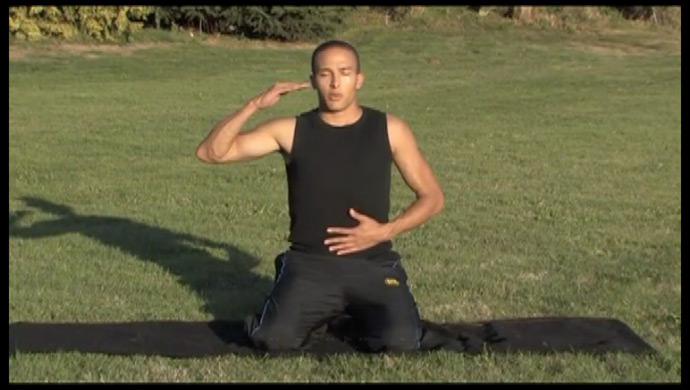
This simple breathing exercise can be used at any time to calm worrying and distressing thoughts and to relieve stress. Unlike other breathing exercises, it is not necessary to set aside a time or place to practise deep breathing.
Instructions:- Sit or stand wherever you can at the time.
- Keeping your shoulders back and elbows down, inhale deeply and hold for 5 seconds
- Exhale slowly.
- Repeat as necessary.
Pursed-Lip Breathing
You use this pursed-lip breathing to ease the shortness of breath caused by stress when you start to panic. Breathing through pursed lips forces you to lengthen the exhalation process, and slows down your breathing. You can use this technique whenever you are experiencing a shortness of breath.
Instructions:- Sit, stand or lie down.
- Relax your neck and shoulder muscles by dropping your elbows to your sides.
- Breathe in through your nose to a count of 3.
- Purse your lips as if you are going to whistle and breathe out slowly to a count of 6 or more. Your exhalation should take at least twice as long as your inhalation.
- Repeat this process until your breathing slows down and you are rid of the shortness of breath.
Calming Breath Exercise
The Calming Breath Exercise was adapted from the ancient discipline of yoga. It is a very efficient technique for achieving a deep state of relaxation quickly.
Instructions:- Breathing in from your abdomen, inhale through your nose slowly to a count of five (count slowly “one…two…three…four…five” as you inhale).
- Pause and hold your breath to a count of five.
- Exhale slowly, through your nose or mouth, to a count of five (or more if it takes you longer). Be sure to exhale fully.
- When you’ve exhaled completely, take two breaths in your normal rhythm, then repeat steps 1 through 3 in the cycle stated.
- Keep up the exercise for at least 3 to 5 minutes. This should involve going through at least two cycles of in-five, hold-five, out-five. As you continue the exercise, you may notice that you can count higher when you exhale than when you inhale. Allow these variations in your counting to occur if they do naturally, and just continue with the exercise for up to 5 minutes. Remember to take two normal breaths between each cycle. If you start to feel light-headed while practising this exercise, stop for 30 seconds and then start again.
- Throughout the exercise, keep your breathing smooth and regular, without gulping in breaths or breathing out suddenly.
- Optional: Each time you exhale, you may say, “Relax”, “Calm”, “Let Go”, or any other relaxing word or phrase silently to yourself. Allow your body to let go as you do this. If you keep this up each time you practice, eventually just saying your relaxing word by itself will bring on a mild state of relaxation.
The calming breath exercise can be a potent technique for halting the momentum of a panic reaction when the first signs of anxiety come on. It is also useful in reducing symptoms of hyperventilation.
Movement Therapy Breathing Techniques
Pranayama (Yogic Breathing)
This exercise is a key part of Yoga, a movement therapy that is known to help people achieve calm. Even though it is part of a movement therapy, it can be done on its own to calm and relieve stress, ease physical pain, and anxiety symptoms, when completing a full Yoga practice is not possible. To have a better understanding of the principles of movement and breathing in yoga, you need to attend classes and be taught properly which this lesson is unable to cover fully. Ujjayi, one of four Yogic breathing techniques, is often called ‘ocean breathing’ because of the gentle sound created through the breathing process. The slow, rhythmic breathing in Ujjayi helps people experience mental calmness and alertness at the same time.
Instructions- You can be in any position.
- Inhale slowly through your nose, it should take 10 -15 seconds.
- Exhale slowly through your nose, it should take 10 -15 seconds.
- When you breathe in again slowly, confine the breathing strictly through your nose and not from the back of the throat.
- When you breathe out slowly, again, confine the breathing out only from your nose and not from the back of the throat.
| Step 1 |  |
You need to stand properly, facing the sun, your hands and palms together, with the two thumbs touching the centre of the chest, and both legs touching side by side. |
| Step 2 |  |
Inhale slowly, raise both hands above your head, and lean your body backwards. |
| Step 3 |  |
Exhale slowly, lean your body forward, place the palms of your hand on the ground in front of your legs, put your forehead against your kneecaps and keep your legs straight. You may not be able to do this at first, and your legs may bend a little bit, but with practice you will be able to keep your legs straight. |
| Step 4 |  |
Inhale deeply and slowly. Stretch your right leg backwards. Then with both hands and the left leg still on the ground, lift your head and look to the front. The left knee now needs to be between the two hands. |
| Step 5 |  |
Hold your breath. Stretch your left leg backwards to join the right leg keeping both legs together. You must maintain a straight body line. Your whole body weight should be supported by the hands and toes. |
| Step 6 |  |
Exhale. Keep the eight parts of your body - legs, toes, kneecaps, hands, chest and forehead - on the ground and raise your stomach slightly. |
| Step 7 |  |
Inhale. Lift up your head slowly, and arch your spine as much as possible. |
| Step 8 |  |
Exhale. Lower your head and lift your body up, with hands and toes still on the ground. |
| Step 9 |  |
Inhale. Bring your left leg forward until the knee touches the head. |
| Step 10 |  |
Exhale. Lift up your body keeping your arms extended and then exhale. Repeat the exercise from the beginning. |
Qigong (or Chi’Kung) is a movement therapy that has been helpful to people with stress and anxiety. It focuses on clearing any blockage to the flow of Qi which coordinates the body and mind with meditative breathing exercises and fluid, graceful movements. Even though it is part of a movement therapy, it can be done on its own to improve breathing and calmness when completing a full Qigong practice is not possible.To have better understanding of the principles of movement and breathing in Qigong, you need to attend classes and be taught properly which this lesson is unable to cover fully.
Two essential forms of breathing in Qigong are pre-birth and post-birth breathing. Though the two breathing styles are meant for different qigong movements, you can use them for re-training your breathing and to lower stress or anxiety. They both involve shallow chest and deep abdominal breathing at the same time, and can give you a sense of relaxation and wellbeing.
Instructions for Pre-birth Breathing:- Start by sitting in a relaxed position, but with good posture. Rest your hands on your thighs.
- Breathe in through your chest and stomach at the same time, bringing in your stomach as you inhale.
- Breathe out completely, allowing your stomach to expand as you exhale.
- Start by sitting in a relaxed position, but with good posture. Rest your hands on your legs.
- Breathe in with the abdomen and allow your lower lungs to fill with air. It will feel like your stomach is expanding from the deep breath you are taking in.
- Keep breathing in, now allowing your upper lungs to fill with air. It will feel as if your chest is filling with air.
- Exhale, allowing your chest to deflate first.
- Continue to exhale allowing your lungs to deflate. It will feel as if your stomach is returning to its original position.
- You can keep this breathing pattern for 10 -15 minutes, which will bring your mind and body to a state of calm.
Wellbeing for the Middle-Aged
- Lie in bed. Close your eyes and inhale. The key is to ‘breathe as smoothly and lightly as silk’. Take time to inhale and exhale and count to 1000. This can increase the resilience to your lungs.
- Use your 10 fingers to comb through your hair 108 times. Start from the forehead and comb through all the way to the nape of your neck. This will soften all the blood vessels in the meridian points on the top of your head. This procedure also helps to be rid of headaches.
- Use both hands to wash your face up and down 108 times. Press the middle finger to the sides of the bridge of your nose as this helps prevent inflammation. Use the rest of your fingers and palm to rub up and down your face as if you are washing your face. This will prevent blockage in the blood vessels, prevents wrinkles, dark spots and reduces headache.
- Use the first section of the thumb bone to rub your eyes 108 times. The inner corner of the eye (next to the bridge of your nose) is the meridian point for bright eyes. Practice rubbing the eyes every day. This can make your eyes brighter and promote sharper vision, reduce teary, fuzzy and blood-shot eyes.
- Use the middle and fourth fingers to massage across your upper and lower eyelids 108 times. This will regulate the blood vessels in your eyes and keep your eyelids firm and help eliminate crow’s feet.
- Use the middle and fourth fingers of both hands to massage your ears 108 times. The fourth finger massages the front of your ears and the middle finger massages up and down the back of your ears. This will help prevent tinnitus.
- Use both hands to rub both ears simultaneously 36 times. Although the surface area of the ear is small, it has over 100 meridian points and they run through the major organs. The left ear belongs to the metal element and the right ear belongs to the wood element. If the ears look dry, sallow, and dull, that is a sign that the person’s health is not good.
- Use the middle finger of both hands to rub the belly button clockwise 108 times. This helps prevent stomach and intestinal problems and boosts the healthier internal organs.